API 610 · Rotordynamics · Centrifugal Pumps
5 Things You Must Verify Before Signing Off on a Pump Rotor Dynamics Report
“API 610 gives you the rules. But knowing which ones get missed most often? That comes from hundreds of pump rotor dynamics reviews.”
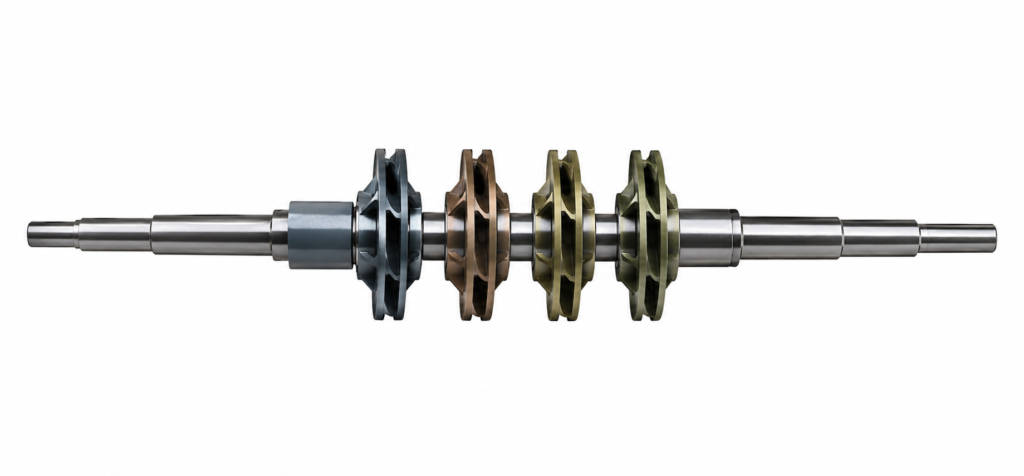
Centrifugal pumps look deceptively simple on paper — a shaft, some impellers, a couple of bearings. But when a pump trips repeatedly near rated speed, or bearing temperatures climb with no clear mechanical cause, what wasn’t verified during design is now costing someone real money.
API 610 sets the minimum standard for centrifugal pumps in heavy-duty process service. Most vendors know the standard. What they don’t always deliver is a rotor dynamics package that has been genuinely interrogated — not just checkbox-compliant. Here are the five areas where gaps appear most often.
Lateral Critical Speed Margins — at the Right Stiffness
API 610 requires critical speeds to sit either below 80% or above 120% of rated speed. Most reports declare a margin. The real question is: at what bearing stiffness?
Hydrodynamic bearing stiffness varies with speed, load, viscosity, and temperature. Per API 610 Annex I (Section I.1.2), damped natural frequencies must be calculated from 25% to 125% of rated speed under three clearance conditions:
As-new with water · As-new with process liquid · 2× as-new with process liquid
What to verify
- Analysis covers the full 25% to 125% speed range, not just rated speed
- All three clearance conditions evaluated, including worn (2×) clearances
- Critical speed margin holds across the full stiffness range — not just at a single nominal point
- Critical speed map (frequency vs. stiffness) provided, not just a single number
- Bearing support stiffness and coupling inertia included in the model
The Damping Factor vs. Frequency Ratio Plot — Primary Stability Screen
This is the most commonly missing or misapplied check. API 610 Annex I, Figure I.1 defines the stability criterion as a plot of damping factor (ξ) against frequency ratio (fn/frun) — where fn is any bending natural frequency and frun is the operating speed. The boundary curve, derived from industry field experience with liquid-handling turbomachines, separates the acceptable region from the unacceptable one.
Unlike compressors and turbines, pumps use damping factor rather than amplification factor. Natural frequencies in pumps rise with speed due to increasing differential pressure across internal clearances, making amplification factor unreliable for this assessment.
| Parameter | Minimum Value | Condition |
|---|---|---|
| ξ (damping factor) | > 0.08 | fn/frun range 0.4 to 0.8 |
| ξ (damping factor) | ≥ 0.15 | Critically damped at operating speed |
| δ (log decrement) | ≥ 0.95 | Equivalent to ξ ≥ 0.15 |
| Fa (amplification factor) | ≤ 3.33 | Equivalent to ξ ≥ 0.15 |
Source: API 610, 12th Edition, Annex I, Section I.1.3
Source: API 610, 12th Edition, Annex I, Figure I.1 — Damping factor versus frequency ratio. The predicted operating point must fall in region 1 for both as-new and 2× as-new clearance conditions.
What to verify
- Figure I.1 plot included with the operating point clearly marked for all modes (API 610 Annex I, Section I.1.3)
- Operating point falls in the acceptable region for both as-new and 2× as-new clearances
- ξ ≥ 0.15 at operating speed; ξ > 0.08 in the subsynchronous range (fn/frun = 0.4 to 0.8)
- Lomakin coefficients calculated for all annular clearances — wearing rings, bushings, balance drum
- If the criterion fails, damped unbalance response analysis performed per Annex I.1.4
Unbalance Response — When the Stability Plot Does Not Close the Case
If any mode fails the Figure I.1 criterion, API 610 Annex I.1.4 requires a damped unbalance response analysis with unbalance set to 4× the allowable value, applied to excite the failing mode. The allowable peak-to-peak displacement is 35% of the diametral running clearance at the point of maximum response (API 610 Annex I, Section I.1.5).
What to verify
- If Figure I.1 failed for any mode, damped unbalance response performed for that mode
- Unbalance set at 4× the allowable value per API 610 Section 9.2.4.2.1
- Peak-to-peak displacement ≤ 35% of diametral running clearance at each cross-section
- Results reported through trip speed, not only up to rated speed
Operating Speed Range — Including VFD Considerations
API 610 Annex I specifies calculations from 25% to 125% of rated speed. For pumps on variable frequency drives — now common in process plants — the actual operating range may span 50% to 105% or wider. This full range must be reflected in the critical speed evaluation and the Figure I.1 plot.
What to verify
- Speed range defined correctly — minimum continuous, rated, maximum continuous, and trip speed
- For VFD-driven pumps, the full VFD speed range reflected in the analysis
- Any restricted speed ranges (RSR) genuinely agreed with the purchaser — not quietly inserted
- Campbell diagram reviewed for coincidences between natural frequencies and integer multiples of running speed
Model Validation — Is the Rotor Model Actually Representative?
The most sophisticated analysis is only as good as the model inputs. Errors in shaft geometry, impeller inertia, or bearing stiffness can shift predicted critical speeds by 10 to 20%. API 610 Annex I explicitly requires the report to state the values and basis of all stiffness and damping coefficients used — the only way an independent reviewer can assess whether the model reflects reality.
What to verify
- Rotor model provided with station geometry, mass distribution, and material properties
- Impeller masses and moments of inertia from actual drawing weights, not generic estimates
- Bearing stiffness and damping from a credible analysis such as BePerf or XLTRC2 — not assumed
- Lomakin coefficients for all annular clearances explicitly reported (API 610 Annex I, Section I.1.2(c))
- Shaft model consistent with final certified drawings, not an early-stage approximation
- If a mechanical run test was done, predicted and measured critical speeds reconciled within acceptable tolerance
The Report Is Not the Analysis
Rotor dynamics compliance for API 610 is a technical argument, not a documentation exercise. A well-formatted report with incorrect clearance assumptions, a missing Figure I.1 plot, or an operating range that doesn’t match actual service conditions is not a passing submission. It is a liability.
The five items above are not exhaustive. They are the places where real problems hide — the gaps between what the standard requires and what actually gets delivered.
When you find a gap, push back. Ask for the Figure I.1 plot with the operating point marked. Ask for the Lomakin coefficient table. Ask for the clearance sensitivity results. A competent vendor will have the data. And if they don’t — that is information too.
References
- API 610, 12th Edition — Centrifugal Pumps for Petroleum, Petrochemical and Natural Gas Industries. American Petroleum Institute. Annex I, Sections I.1.1 through I.1.5, Figure I.1.
- API 684, 2nd Edition — API Standard Paragraphs Rotordynamic Tutorial: Lateral Critical Speeds, Unbalance Response, Stability, Train Torsionals, and Rotor Balancing. American Petroleum Institute.
- API 670, 5th Edition — Machinery Protection Systems. American Petroleum Institute.
- Black, H.F. and Jenssen, D.N. (1970) — Dynamic Hybrid Bearing Characteristics of Annular Controlled Leakage Seals. Proc. IMechE, Vol. 184.
- Childs, D.W. (1993) — Turbomachinery Rotordynamics: Phenomena, Modeling, and Analysis. John Wiley and Sons.